Singapore Immigration Policy Updates 2026: 7 Powerful Work Visa Changes
Singapore Immigration Policy Updates 2026 are bringing important changes for foreign professionals, skilled workers and employers. The latest framework includes the September 2026 expansion of the Non-Traditional Source Occupation List, higher Employment Pass and S Pass salary thresholds scheduled for 2027, a new AI and Tech ONE Pass track, updated employer quotas and continuing digital work-pass improvements.
This briefing focuses only on employment-related immigration and is designed for professionals planning to relocate to Singapore for work and employers hiring international talent.
Table of Contents
- Singapore Immigration Policy Updates 2026: At a Glance
- September 2026 NTS Occupation List Expansion
- Employment Pass Salary Changes
- S Pass Salary Changes
- COMPASS Requirements
- New ONE Pass AI and Tech Track
- Singapore Work Pass Fees
- Work Pass Processing Times
- Foreign Worker Quotas and Levies
- Latest Foreign Workforce Numbers
- Consultations and Proposed Changes
- Confirmed vs Upcoming Policy
- Work Relocation Checklist
- FAQ
- Sources
Singapore Immigration Policy Updates 2026: At a Glance
Seven Important Work-Immigration Developments
- NTS Occupation List expansion: Eight additional occupations became eligible from 1 September 2026 under specified Work Permit conditions.
- Employment Pass: The minimum qualifying salary rises from S$5,600 to S$6,000 for new applications from 1 January 2027.
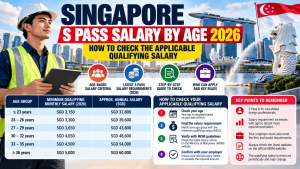
- S Pass: The minimum qualifying salary rises from S$3,300 to S$3,600 for new applications from 1 January 2027.
- AI and Tech talent: A new ONE Pass AI and Tech track is scheduled for January 2027.
- Work-pass processing: Online EP and S Pass applications are generally processed or updated within 10 business days.
- Employer quotas: S Pass and Work Permit hiring remains subject to sector-specific dependency ceilings and quotas.
- Foreign workforce: Singapore recorded 1,635,700 foreign workers across work-pass categories at December 2025.
1. Singapore Immigration Policy Updates 2026: NTS Occupation List Expansion
The most directly relevant change already in force during September 2026 is Singapore’s expansion of the Non-Traditional Source Occupation List (NTS-OL).
Confirmed effective date
Effective: 1 September 2026
Authority: Singapore Ministry of Manpower (MOM)
Audience:
EMPLOYERS
SKILLED WORKERS
MOM announced in March 2026 that eight new occupations would be added to the NTS Occupation List from September 2026. The purpose is to allow eligible businesses to recruit workers from non-traditional source countries for specified roles where employers face difficulty attracting local workers.
Occupations covered by the September expansion
| Area | New Occupations / Roles |
|---|---|
| Air transportation | Cabin attendants |
| Social services | Babysitters / infant caregivers; child / after-school care centre workers; teacher aides |
| Food services | Butchers, fishmongers and related food preparers; food/drink stall assistants; kitchen assistants; waiters |
Important NTS controls
- An 8% NTS sub-dependency ratio ceiling applies to manage overall NTS Work Permit numbers.
- NTS Work Permit holders under the expanded list must generally receive a fixed monthly salary of at least S$2,000.
- Additional sector-specific licensing and employer requirements apply.
Why this matters – Employers: Businesses in eligible sectors can access a wider international recruitment pool for specified roles, subject to the NTS quota, salary and sector requirements.
This is a confirmed September 2026 implementation, not merely a future proposal.
2. Employment Pass Salary Threshold Rises in 2027
The Employment Pass remains Singapore’s principal work pass for foreign professionals, managers, executives and specialised professionals. The current 2026 minimum qualifying salary is S$5,600 per month
| Employment Pass | Current 2026 | From 1 January 2027 |
|---|---|---|
| All sectors except financial services | S$5,600/month | S$6,000/month |
| Financial services | S$6,200/month | S$6,600/month |
| Maximum age-adjusted EP salary outside financial services | Up to S$10,700 | Up to S$11,500 |
| Maximum age-adjusted EP salary in financial services | Up to S$11,800 | Up to S$12,700 |
Exact implementation dates
New EP applications: 1 January 2027
EP renewals expiring from: 1 January 2028
Issuing authority: Ministry of Manpower
The salary threshold is benchmarked against the top one-third of local Professionals, Managers, Executives and Technicians. The salary also rises progressively with age.
Why this matters – Skilled workers/employers: Professionals targeting Singapore should evaluate their expected salary against the 2027 threshold before accepting an offer, while employers should review compensation packages ahead of the new application date.
Date clarification: S$6,000 is not the minimum EP salary for applications submitted on 15 September 2026. The current 2026 threshold remains S$5,600 outside financial services.
3. S Pass Minimum Salary Will Increase to S$3,600
The S Pass is designed for skilled foreign workers in Associate Professional and Technician roles. MOM has confirmed another salary adjustment beginning in 2027.
| Sector | Current Minimum | New Minimum From 1 Jan 2027 |
|---|---|---|
| All sectors except financial services | S$3,300 | S$3,600 |
| Financial services | S$3,800 | S$4,000 |
As with the EP, the S Pass salary requirement increases progressively with age. For example, under the current 2026 scale outside financial services, the minimum rises from S$3,300 for candidates aged 23 or below to S$4,800 for candidates aged 45 or above.
Why this matters – Skilled workers/employers: Employers using S Passes need to factor the 2027 salary floor into recruitment budgets, while candidates should assess whether their salary and age profile meets the applicable threshold.
4. Employment Pass Applicants Still Need to Clear COMPASS
Meeting the Employment Pass salary requirement is only the first stage. Unless exempt, applicants must also pass Singapore’s Complementarity Assessment Framework (COMPASS).
COMPASS at a glance
- C1 – Salary: Based on the candidate’s fixed monthly salary compared with local PMET salaries in the sector.
- C2 – Qualifications: Assesses the candidate’s qualifications.
- C3 – Diversity: Considers the employer’s workforce profile.
- C4 – Support for strategic skills: Rewards relevant skills where applicable.
- Employers must also satisfy the applicable Fair Consideration Framework requirements.
MOM’s C1 salary benchmarks are updated annually. The benchmark applicable to new EP applications from 1 January to 31 December 2026 was released in August 2025, while the benchmark for 2027 applications was released in August 2026.
Candidates earning at least S$22,500 fixed monthly salary are exempt from COMPASS, subject to the applicable rules.
Why this matters – Skilled workers/employers: A high salary alone does not necessarily establish EP eligibility; employers should evaluate the complete COMPASS profile before submitting an application.
5. New ONE Pass AI and Tech Track Coming in January 2027
New work-pass track
Expected launch: January 2027
Authority: Ministry of Manpower
Audience:
AI & TECH PROFESSIONALS
EMPLOYERS
Singapore plans to introduce a new ONE Pass (AI and Tech) track in January 2027. MOM says this will replace the existing Tech.Pass and provide more attractive terms for top AI and technology talent.
A notable feature is that applicants will be allowed to meet the fixed monthly salary criterion using a combination of cash and non-cash compensation, including qualifying employee share arrangements.
Current status on 15 September 2026
The AI and Tech track is an announced future work-pass route. It is not a new pass that can be applied for on 15 September 2026. MOM has stated that candidates may apply under the AI and Tech track from 28 January 2027.
Why this matters – Skilled workers: Senior AI and technology professionals may have a new route that recognises both cash and qualifying equity-based compensation when the new track opens.
6. Singapore Work Pass Fees in 2026
Singapore’s main work-pass fees are relatively straightforward, but applicants and employers should distinguish the application fee from the issuance fee.
| Work Pass | Application Fee | Issuance Fee |
|---|---|---|
| Employment Pass | S$105 | S$225 |
| S Pass | S$105 | S$225 |
| Personalised Employment Pass | S$105 | S$225 |
| Overseas Networks & Expertise Pass | S$105 | S$225 |
| Work Permit | S$35 | S$35 |
These are the current published MOM fees. No separate work-pass fee increase specifically announced for 15 September 2026 was identified in the official MOM material reviewed.
Why this matters – Skilled workers/employers: Applicants can budget the basic government pass charges separately from employer levies, medical insurance and other employment-related costs.
7. Singapore Work Pass Processing Times
| Pass | Typical Official Processing Time |
|---|---|
| Employment Pass | Processed or updated within 10 business days |
| S Pass | Processed or updated within 10 business days |
| Work Permit | Within 1 week for most cases |
| Personalised Employment Pass | Within 6 weeks for most cases |
| ONE Pass | Within 4 weeks for most cases |
Processing times are official service expectations for most cases, not guaranteed approval timelines. Applications requiring additional information can take longer.
8. Singapore Foreign Worker Quotas and Levies
Singapore’s work-pass system combines salary requirements with employer-level workforce controls. This is particularly important for S Pass and Work Permit recruitment.
| Sector | Foreign Worker Dependency Ratio Ceiling | S Pass Sub-Quota |
|---|---|---|
| Services | 35% | 10% |
| Manufacturing | 60% | 15% |
| Construction | 83.3% | 15% |
| Process | 83.3% | 15% |
| Marine shipyard | 75% | 15% |
The S Pass levy is currently S$650 per month across sectors and levy tiers. The levy is an employer cost rather than a visa fee paid by the worker.
For Work Permit hiring, the dependency ratio ceiling varies by sector, while the applicable levy depends on sector, worker skill level and other factors.
Why this matters – Employers: A company can have a suitable foreign candidate and still be unable to obtain a pass if its applicable workforce quota has been reached.
9. Local Qualifying Salary Increased in 2026
MOM raised the Local Qualifying Salary (LQS) from S$1,600 to S$1,800 per month on 1 July 2026.
The LQS affects how local employees are counted when determining an employer’s Work Permit and S Pass quota entitlement.
Why the LQS matters
- A local employee earning at least S$1,800 per month generally counts as one local employee for quota purposes.
- An employee earning between S$900 and below S$1,800 generally counts as 0.5 of a local employee.
- Employees below S$900 are not counted for this purpose.
Why this matters – Employers: The LQS directly affects how many Work Permit and S Pass holders a company can employ, making it relevant to workforce planning.
10. Latest Singapore Foreign Workforce Numbers
MOM’s latest published foreign workforce series provides data through December 2025. A September 2026 official total for the foreign workforce was not identified in the published dataset reviewed, so December 2025 is clearly labelled as the latest available annual figure rather than presented as a September 2026 number.
| Pass Category | December 2025 |
|---|---|
| Employment Pass | 203,300 |
| S Pass | 178,900 |
| Work Permit – Total | 1,222,700 |
| Other work passes | 30,800 |
| Total foreign workforce | 1,635,700 |
The figures show the scale of Singapore’s foreign workforce framework and why MOM continues to use salary benchmarks, quotas and sector-specific controls alongside work-pass eligibility.
11. Work Permit Digitalisation Continues Through 2026 and 2027
MOM is also progressively moving Work Permit transactions into the myMOM Portal. The roadmap began with application and appeal functions, followed by Work Permit issuance functions from May 2026.
MOM plans to introduce the cancellation function in the second half of 2026 and renewal functionality in the first half of 2027, with the broader enhancement programme targeted for completion by the end of 2027.
Why this matters – Employers: Employers managing Work Permit holders should expect more transactions to move into a single digital workflow, reducing paper-based administrative steps.
12. Proposed and Future Policy Changes: What Is Not Yet Effective?
ONE Pass AI and Tech
Status: Announced future policy.
Expected application date: 28 January 2027.
This is not an available new route on 15 September 2026.
Employment Act Review
MOM has been reviewing the Employment Act and consulting tripartite partners on how the framework can remain appropriate for different worker groups and employers. However, no new work-immigration legislation from this review was identified as being formally announced during 9–15 September 2026 in the official sources reviewed.
2028 Work Permit Levy Changes
MOM has announced that the revised Work Permit levy schedule will take effect from 2028. This includes streamlining the levy framework and changes affecting certain sectors.
These are future employer-cost changes and should not be presented as a September 2026 visa-fee increase.
Research finding for 9–15 September 2026: No new formal Singapore government consultation specifically creating a new professional work visa or changing the EP/S Pass salary floor was identified during this week’s official-source review. The significant September implementation was the NTS Occupation List expansion effective 1 September.
13. Confirmed Policy vs Current 2026 Policy vs Future Changes
| Issue | Status on 15 Sep 2026 | Correct Interpretation |
|---|---|---|
| NTS Occupation List | Confirmed / effective | Expanded occupations apply from 1 September 2026 under specified conditions. |
| EP S$6,000 salary | Future / confirmed | Applies to new EP applications from 1 January 2027. |
| S Pass S$3,600 salary | Future / confirmed | Applies to new applications from 1 January 2027. |
| ONE Pass AI and Tech | Future | Applications begin 28 January 2027. |
| S$5,600 EP minimum | Current 2026 | Still applies to new applications before 1 January 2027, subject to age, sector and COMPASS rules. |
| S$3,300 S Pass minimum | Current 2026 | Still applies to new applications before 1 January 2027, subject to age and sector rules. |
| 2028 levy restructuring | Future | Not a September 2026 levy increase. |
No material conflict was identified between the official MOM sources reviewed. The main potential source of confusion is the mixing of current 2026 salary thresholds with thresholds already announced for 2027.
What Work Professionals Should Check Before Moving to Singapore
Singapore Work Relocation Checklist
- Check your pass category: Determine whether your role fits the EP, S Pass, ONE Pass or another work-pass route.
- Check your salary: Compare your fixed monthly salary with the applicable 2026 or 2027 threshold.
- Check your age: EP and S Pass salary thresholds increase progressively with age.
- Check COMPASS: EP applicants generally need to meet the COMPASS framework unless an exemption applies.
- Check the employer: S Pass and Work Permit hiring is affected by employer quotas.
- Check the effective date: Do not use the 2027 salary thresholds for an application governed by the 2026 rules.
- Check sector rules: Financial services and several Work Permit sectors have different salary or quota requirements.
- For AI and tech leaders: Monitor the ONE Pass AI and Tech track ahead of its January 2027 opening.
Singapore Immigration Policy Updates 2026 – FAQ
What are the latest Singapore Immigration Policy Updates 2026 for work professionals?
The major work-focused developments include the NTS Occupation List expansion effective 1 September 2026, higher EP and S Pass salary thresholds scheduled for 2027, the planned ONE Pass AI and Tech track, updated employer quota controls and continued digitalisation of Work Permit services.
What is the Singapore Employment Pass salary requirement in 2026?
The current minimum EP qualifying salary is S$5,600 per month for sectors other than financial services and S$6,200 for financial services, with the requirement increasing progressively with age.
When will Singapore’s Employment Pass salary increase to S$6,000?
The S$6,000 minimum applies to new Employment Pass applications from 1 January 2027. Renewals of passes expiring from 1 January 2028 will also use the new framework.
What is the S Pass salary requirement in Singapore in 2026?
The current minimum is S$3,300 per month outside financial services and S$3,800 in financial services, with age-based increases.
When will Singapore’s S Pass salary increase to S$3,600?
The S$3,600 minimum for sectors other than financial services applies to new S Pass applications from 1 January 2027. Financial services rises to S$4,000.
What changed in Singapore’s NTS Occupation List in September 2026?
Eight occupations were added from 1 September 2026 across air transportation, social services and food services. Eligible employers can hire workers from non-traditional source countries for those specified roles, subject to NTS quota, salary and sector controls.
What is the new ONE Pass AI and Tech track?
Singapore plans to introduce a ONE Pass AI and Tech track that replaces the Tech.Pass and provides more attractive terms for top AI and technology talent. MOM says applications can begin from 28 January 2027.
How long does a Singapore Employment Pass application take?
MOM states that online Employment Pass applications are generally processed or given an update within 10 business days. Cases requiring additional information may take longer.
How much does a Singapore Employment Pass cost?
The published fee is S$105 when the application is submitted and S$225 when the Employment Pass is issued.
Does Singapore have a quota for foreign workers?
Yes. S Pass and Work Permit hiring is subject to sector-specific dependency ratio ceilings and sub-quotas. Employment Passes are not subject to the same employer quota system.
Blog Angle
“Singapore Immigration Policy Updates 2026: 7 Powerful Work Visa Changes Skilled Professionals Need to Know”
A strong editorial angle is to show how Singapore is simultaneously widening access to selected foreign-worker occupations while raising the quality and salary bar for professional work passes. The key story is the combination of the September NTS expansion, higher 2027 EP/S Pass salary thresholds and the upcoming AI and Tech ONE Pass.
Planning to Relocate to Singapore for Work?
Singapore’s work-pass system considers salary, occupation, age, employer profile, sector requirements and, for Employment Pass applicants, COMPASS eligibility.
Check Your Eligibility Contact Our ExpertsSources
Official Singapore Government Sources
- MOM – Partnering Businesses and Workers to Thrive in a Changed World, 3 March 2026
- MOM – NTS Occupation List Requirements From 1 September 2026
- MOM – Employment Pass Eligibility and Salary Requirements
- MOM – COMPASS Salary Benchmarks
- MOM – Employment Pass Application and Processing
- MOM – S Pass Eligibility and Salary Requirements
- MOM – S Pass Application and Processing
- MOM – S Pass Quota and Levy Requirements
- MOM – Work Permit Application, Fees and Processing
- MOM – Personalised Employment Pass
- MOM – Overseas Networks & Expertise Pass
- MOM – ONE Pass AI and Tech Track
- MOM – Foreign Workforce Numbers
- MOM – Local Qualifying Salary
- MOM – Work Permit eService Enhancement Roadmap
- MOM – S Pass Salary Data, 10 September 2026
- MOM – Official Announcements
Research date: 15 September 2026. This article distinguishes confirmed September 2026 changes from current 2026 rules and future 2027/2028 measures. No new professional work-visa consultation or EP/S Pass salary change specifically announced during 9–15 September 2026 was identified in the official MOM sources reviewed.